

Pre-2006
Industry:
1997: First IEEE Wi-Fi standard (802.11) released, initiating widespread WLAN adoption.
2001: 3G networks begin commercial deployment, marking the start of mobile broadband growth.
2004: LinkedIn launches, introducing professional social networking.
2005: Facebook launches, accelerating global social media adoption.
2006
Industry: Global cellular networks expand; early integration of VoIP with cellular networks highlights the importance of heterogeneous networks. YouTube launches, followed shortly by Twitter, driving user-generated mobile content growth.
Ranplan Born: Founded by Professor Jie Zhang (CScO, Joyce Wu (COO) and Hui Song (CTO). First project, iPlan, focuses on RAN planning for buildings.
2007
Industry: First iPhone released, reshaping mobile broadband demand and influencing future cellular planning.
Ranplan: Research advances on radio propagation and the impact of building materials on wireless performance.

2008
Industry: Initial LTE trials lay the foundation for global LTE standardization and future 4G deployments.
Ranplan: Development of network planning and optimization tools for 3G, WiMAX, and LTE.

2009
Industry: First commercial 4G (LTE) services deployed in Stockholm & Oslo.
Ranplan: Prepares commercial releases of planning tools.

2010
Industry: Mobile data usage surges; Wi-Fi hotspots becomes widespread in public and enterprise environments. Instagram launches, reinforcing mobile-first usage.
Ranplan: Launches iBuildNet™ at the 4G World Conference in Chicago.

2011
Industry: Snapchat launches; Apple introduces Siri on iPhone 4S, increasing demand for low-latency networks.
Ranplan: Commercial release of iBuildNet® Standard at China P&T Expo.
2012
Industry: Formation of FirstNet Authority begins planning the first nationwide broadband public safety network in the US.
Ranplan: Concluded partnership in the EU “IAPP@RANPLAN” project to automate RAN planning and optimization.
2013
Industry: Wi‑Fi 802.11ac (“Wi‑Fi 5”) released, significantly increasing throughput and network planning complexity.
Ranplan: Launches iBuildNet & iBuildNet‑Fi at WBA Wi‑Fi Global Congress; adoption by Huawei & China Mobile.

2014
Industry: Operators prepare for dense small-cell deployments to enhance urban and indoor capacity.
Ranplan: Releases its first commercial HetNet planning software, Ranplan Professional (initially known as iBuildNet).
2015
Industry: Wearables such as Apple Watch increase device density; 3GPP begins formal 5G NR standard work.
Ranplan: Launches iBuildNet Tablet for real‑time on‑site planning.
2016
Industry: Public safety discussions intensify around LTE-based mission-critical broadband. Douyin (TikTok China) gains rapid adoption.
Ranplan: Expands in-building LTE and small-cell planning capabilities to support public safety, enterprise, and healthcare environments.
2017
Industry: AT&T awarded the FirstNet nationwide public safety network; TikTok launches globally.
Ranplan: Participates in the EU WAVECOMBE mmWave research project, enhancing iBuildNet 4.0 and rebranding it as Ranplan Professional.

2018
Industry: Initial commercial 5G NR rollouts begin worldwide. US FCC finalizes CBRS framework, enabling shared spectrum and accelerating private LTE planning.
Ranplan: Lists on Nasdaq First North Stockholm and releases its first in-building 5G HetNet planning tool.
2019
Industry: 5G trials and early deployments expand; CBRS-based private LTE gains traction across enterprises and venues.
Ranplan: Begins a major UK Innovate project; leads the EU BANYAN project and launches Collaboration Hub.

2020
Industry: COVID-19 increases remote work applications; Open RAN gains momentum through vendor diversification and disaggregated network initiatives.
Ranplan: Introduces Ranplan Maxwell RF engine for mmWave & cloud simulation, named after the famous Cambridge Professor, James Clerk Maxwell.
Launches Ranplan Device Hub (D-Hub).

2021
Industry: Global 5G deployments accelerate using NSA architectures; 3GPP Release 17 introduces formal support for Non-Terrestrial Networks (NTN), integrating satellites into the cellular ecosystem.
Ranplan: Releases Automatic Cell Optimizer for dense network automation.

2022
Industry: Wi-Fi 6 and Wi-Fi 6E adoption accelerates. Open RAN architectures transition from trials toward deployment. Private LTE/5G expands across enterprises and critical infrastructure.
Ranplan: Enhances vendor-neutral planning workflows aligned with Open RAN and disaggregated network architectures.

2023
Industry: FirstNet nationwide build is complete across all 50 states, delivering priority broadband to first responders.
Ranplan: Delivers advanced URLLC simulations and supports complex 5G private wireless projects.

2024
Industry: Wi‑Fi 7 begins rollout, driving planning for extremely high‑density environments. Early NTN trials combine terrestrial and LEO satellite connectivity for coverage extension and resilience.
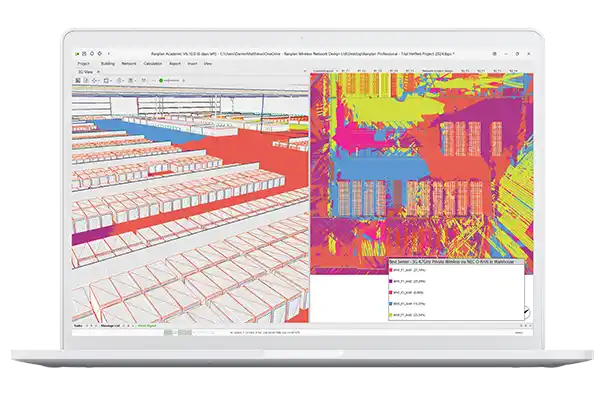
Ranplan: Integrates IFC imports from BIM & LiDAR into network planning workflows.
2025
Industry: NG911 modernization and public safety broadband upgrades influence next-generation network requirements.
Ranplan: Collaborates with Hitachi Energy on signal propagation analysis for TETRA, Wi‑Fi 6, and VHF/AIS networks at offshore substations and wind farms.

2026
Industry: 6G commercial expectations by ~2030 with early standardization activity through late 2020s; further convergence of public safety broadband and mission-critical communications.
Ranplan Outlook: Continued focus on AI-enabled tools, digital twins, multi-RAT planning, and NTN integration.
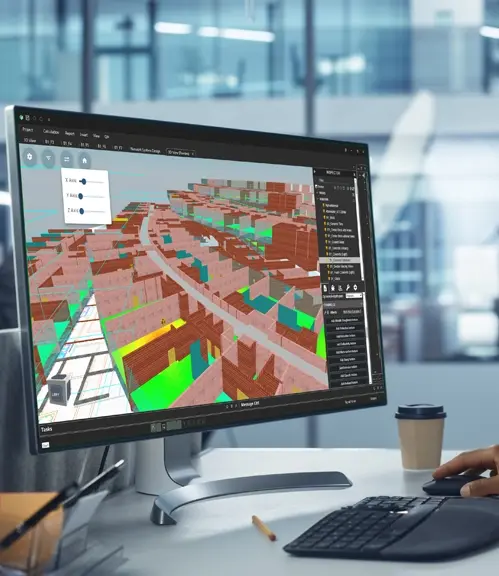
Maximize productivity and efficiency in industrial environments with Ranplan’s precise network planning solutions